19+ in Ontario, 18+ in Alberta, Manitoba and Quebec. The rating shown here is the operator rating reported by the site owner on 19 October 2026: five stars from 4,889 reviews. Availability depends on where you are and on eligibility. Deposit routes, cashout timing, verification steps, offer structure, wagering and limits are set by the operator and are not stated here — read them in the cashier and in the current terms after you sign in. We do not guarantee payout speed or availability in your province. Gambling costs money; treat any balance as spent. Checked: 19 October 2026.
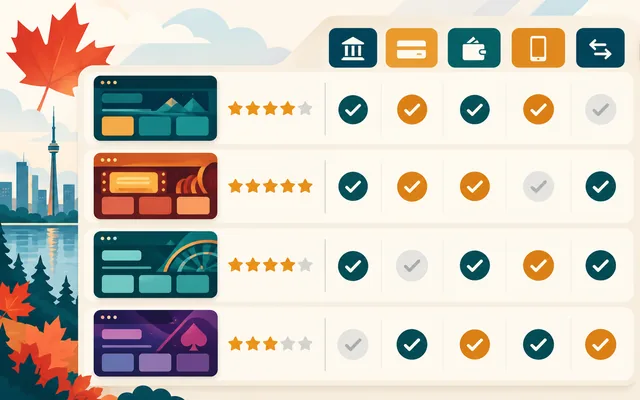
Every top Canadian casino online list looks the same from the outside: a column of logos, a column of stars, a button. The useful question is never which site sits first, it is what put it there. This page sets out eight signals you can verify on the operator's own pages in an afternoon, and shows how to score them yourself.
By the OntarioCashout desk · checked October 19, 2026 · 19+ Ontario
Top Canadian casino online: ranked by what, exactly?
Somebody typing top Canadian casino online is not asking for a beauty contest. They are asking a practical question with money attached: where can I put a few hundred dollars, play without wondering who holds it, and get the balance back out through a route my bank recognizes. That question has answers. The trouble is that the usual format of the answer, a ranked row of brands, hides the one thing that would make it checkable.
Ask any list what it ranked on and the silence is the finding. Payout speed, welcome bonus size, number of games, mobile layout, and commercial terms between the site and the operator are five different orderings. Each produces a different first place, and all five can be defended with a straight face. A list that will not say which one it used has not ranked anything; it has arranged logos in a sequence and added stars afterwards.
So the structure here is deliberately inverted. Instead of handing you a winner, the next sections set out eight signals that are published, dated, and checkable without insider access: register status, deposit routes, withdrawal routes, minimum thresholds, how the bonus conditions are written, which self-limitation tools exist, how support is built, and how verification is disclosed. Score an operator on those eight and you have a ranking you can defend to yourself.
The test for each criterion is the same. Can you confirm it in under five minutes, from a source the operator does not control, or from a page it publishes and is bound by? If yes, it belongs in a ranking. If the only evidence is a sentence on a review site, it belongs in a conversation, not a table. Everything below passes that test, which is why none of it reads like marketing copy.
Why a five-star rating with no criteria is not a rating
A star score is an output. Ratings are only meaningful when you can see the inputs, the weights, and the date, and casino top lists almost never publish any of the three. Four and a half stars out of five implies a measurement precise to a tenth of a unit on something nobody has defined. Change the weighting of payout speed against bonus size by a few points and the whole column reshuffles, which tells you the precision was never real.
Review counts have the same problem in a different coat. A number next to a brand looks like evidence, and it is evidence of exactly one thing: that a number of people left feedback somewhere. It says nothing about who they were, what they were asked, whether the sample was filtered, or when any of it happened. A count is a volume measure, not a quality measure, and treating it as a verdict is how a popularity figure gets mistaken for a safety signal.
This matters more in gambling than in most verticals, because the downside of picking wrong is not a bad dinner. It is a balance you cannot withdraw, a bonus condition you did not notice, or a dispute with no obvious route of escalation. The protective information is boring and specific: who the counterparty is, which register it appears on, what it says about limits and documents. Stars compress all of that into a shape that fits a template.
There is nothing wrong with a site stating its own score, as long as the score is labelled for what it is and the page also gives you the underlying facts. Our own position on the partner this site works with is set out plainly in the last section: a five-star rating and 4 889 reviews, named as a rating and a review count, with the operational details left where you can read them for yourself in the cashier.
A usable rating names its criteria, its weights and the date it was measured.
A review count measures how many people spoke, never what the thing is worth.
If changing one weight would reorder the list, the ranking was never precise.
Anything decision-relevant should be checkable on a page the operator is bound by.
Criterion one: registration on the iGaming Ontario register
Ontario is the only province that opened its own regulated internet gaming market to private operators. The Alcohol and Gaming Commission of Ontario registers the companies and sets the standards; iGaming Ontario holds the commercial agreements with the operators that go live. The arrangement produces something unusual and genuinely useful for players: a public list of who is permitted to offer gaming to people in the province, maintained by the regulator rather than by the industry.
That list is the single most valuable criterion on this page, and it is also the easiest to check. You search for the brand as it appears on the website, and you also check the legal entity named in the footer or the terms, because the two frequently differ and a brand can be operated by a company with a different name. Start at our walkthrough of the register, which explains what each field in an entry means and what to do when a name does not appear.
Being on the register is not a quality award. It means the operator has passed the regulator's registration requirements and agreed to operate under Ontario's standards, which covers advertising rules, responsible gambling obligations, game and system requirements, and the handling of player funds and complaints. What it does not promise is fast payouts, good support, or fair bonus terms. Those are separate criteria, which is exactly why they get their own sections below.
This site deliberately does not state that any particular operator is registered. Registration status changes, entries are added and removed, and a sentence written in October is not evidence in March. The check takes a minute, it is free, and it is the one piece of due diligence nobody else can do for you. Do it on the day you intend to deposit, not on the strength of a badge in a footer or a line in a comparison table.
Nothing on this page should be read as confirmation that a named operator is registered today — the register is public, and that check is yours to make before you deposit.
A list is only useful if it says what it was ranked on. Ours says it in the first table.
Ontario and the rest of Canada are two different markets
Outside Ontario the structure is provincial and far older. Each province runs gaming through its own corporation: OLG in Ontario alongside the private market, Loto-Québec in Quebec, BCLC in British Columbia, and PlayAlberta in Alberta, with the Atlantic and prairie provinces organized through their own bodies. These are monopoly platforms rather than registers of private companies, so there is no equivalent public list of approved private operators to consult.
The practical consequence is that the first criterion behaves differently depending on where you live. An Ontario resident can resolve the counterparty question with a search. Someone in Nova Scotia or Saskatchewan cannot, because the provincial model was never designed to register private operators in the first place. The risk profile is not the same, the escalation route if something goes wrong is not the same, and a list that treats the whole country as one market quietly papers over both differences.
What travels across all provinces is the money. Canadian banking behaves the same way everywhere, which is why Interac dominates deposits nationally and why bank-side processing times look similar from Victoria to St John's. Cashier pages, minimum thresholds, and the documents requested at verification are also set by the operator rather than by the province, so most of the criteria below apply wherever you are reading this.
So treat a national ranking as two overlapping lists. For Ontario, register status is the first filter and everything else follows. For the rest of Canada, the provincial platform is the regulated option, and anything beyond it needs the remaining seven criteria applied with more weight, because the first one cannot do the work. Our overview of real money play across Canada takes that split as its starting point.
Criterion two: the deposit methods actually on the cashier page
Payment support is the criterion that decides whether an operator is usable for you at all, and it is the one most often reported wrongly. Method lists on comparison pages go stale the moment a processor relationship changes, and the logos in a website footer are frequently decorative. The only authoritative list is the one that renders inside your account on the cashier page, filtered for your province and your currency, which means it is also a list you can read before committing anything.
Breadth looks impressive and matters less than you would think. Twelve logos are worth nothing if ten of them are wallets you do not hold. What you actually need is two routes you can use today, at least one of which works in both directions, plus a plausible fallback if your bank declines a transaction. For most Canadian players that means an Interac route as the primary and a card or wallet as the backup.
Each method also behaves differently in ways worth knowing before you choose. Interac and Interac e-Transfer connect to your bank account directly. InstaDebit acts as an intermediary that holds the bank credentials instead of the casino. MuchBetter is a wallet with its own app and its own balance. Paysafecard is a prepaid voucher, which makes it excellent for capping what you deposit and useless as a way of getting paid.
The table below is the shape your own research should take. It lists the routes Canadian players ask about most, how each one moves money, whether it is normally available for payouts as well as deposits, and the specific thing to look for on the cashier page. Fill the last column from the operator you are considering rather than from this page, because fees and availability are operator-specific and change without notice.
Deposit and withdrawal routes Canadian players ask about, and what to confirm for each
Method
How the money moves
Normally available for payouts
What to confirm on the cashier page
Interac
Debit from your bank account through the Interac network
Often yes
Whether payouts use the same route and which bank list is supported
Interac e-Transfer
Email or phone transfer between bank accounts
Often yes
Whether the registered email matches your casino account name
InstaDebit
An intermediary account linked to your bank
Often yes
Any account fee on the InstaDebit side, separate from the casino
MuchBetter
Wallet balance held in the MuchBetter app
Often yes
That the phone number on the wallet matches your account details
Paysafecard
Prepaid voucher code bought in cash or online
Usually no
Which alternative route payouts will take instead
Visa or Mastercard debit
Card transaction through your bank
Sometimes
Whether the issuer declines gaming transactions
Bank transfer
Direct transfer between bank and operator
Usually yes
The minimum amount and how many business days are quoted
Criterion three: whether the withdrawal list mirrors the deposit list
Here is the gap that catches most people out. An operator can advertise seven ways to put money in and support three ways to take it out, and nothing in the marketing will tell you which is which. The deposit list is a sales page. The withdrawal list is an operations page, and it is shorter because moving money outward carries obligations the inward direction does not: source-of-funds checks, anti-fraud review, and the need to pay a verified account holder.
Most operators also apply a closed-loop rule, returning funds by the route they arrived on. That is sensible policy and an unpleasant surprise if you funded with a prepaid voucher, because the voucher cannot receive money and your payout gets pushed onto whatever fallback the operator chooses. Sometimes that is a bank transfer taking several business days; sometimes it needs new documents. Either way, the deposit decision quietly set the payout terms.
So check the withdrawal side first, before you fund anything, and check it inside the account rather than in a help article. Three things are worth writing down: which routes appear for payouts in your province, whether each one carries a fee, and whether the operator states a limit per transaction, per day, or per month. A monthly ceiling is the one that stings, because it only becomes relevant after you have won.
A useful habit is to test the chain with a small amount before you need it to work. Deposit modestly, play normally, then withdraw a small sum and watch what actually happens: what the operator asks for, how long each stage takes, and whether the money lands by the route you expected. One small round trip tells you more about an operator than every review you will read about it.
Criterion four: minimum thresholds, in both directions
Minimums are published, specific, and comparable, which makes them unusually good ranking material. There are two of them and they are not the same number. The deposit minimum is the smallest amount the cashier will accept, and operators keep it low because a low barrier helps them. The withdrawal minimum is the smallest amount the operator will process outward, and that one is frequently higher, much less prominently displayed, and the one that matters when a small balance is stuck.
The searches people run around this are revealing: five dollar minimum deposit, ten dollar minimum deposit, twenty dollar minimum, no minimum at all. Those are the questions arriving, not promises anyone should be making. Behind them sits a real constraint, because a payment route has a cost per transaction and a two dollar deposit through a bank rail does not cover it. Where you see a very low floor, the economics usually sit elsewhere, often in the bonus attached to it.
Pair each threshold with the method, because a single number across the whole cashier is rare. Card and Interac floors often differ from wallet floors, and a prepaid voucher has its own denominations. Our breakdowns of minimum deposit casinos and of the five dollar deposit question go through how those floors are set and which combinations are actually workable in Canada.
One more number belongs in the same column: the minimum that triggers a fee. Some operators process a small payout free above a stated amount and charge below it, or allow one free withdrawal per period and charge for the rest. None of that is hidden, but it is rarely in the first paragraph of anything. Read the payments page twice and note the figures before you decide where an operator sits in your ranking.
Criterion five: how the bonus terms are written
A bonus is a contract, and the interesting part of a contract is never the headline number. Two hundred per cent on a first deposit means nothing on its own; what determines whether it is worth accepting is the wagering multiple, what that multiple applies to, which games count and at what weighting, the maximum stake permitted while bonus funds are live, how long the offer stays active, and the ceiling on what can be converted to cash.
That is why this criterion scores the writing rather than the size. A transparent operator states the conditions in full, in one place, in plain language, with the numbers visible before you opt in. An opaque one spreads them over a promotions page, a terms document, and a help article, and leaves you to assemble them. The second pattern is a reliable signal about how the rest of the relationship will feel, long before any money is at stake.
The maximum bet clause deserves singling out, because it is the one that voids more winnings than any other. A low cap per spin while a bonus is active is standard and reasonable; what causes the damage is that it is easy to breach by accident during ordinary play and the consequence is usually forfeiture of the bonus and anything won with it. If a page cannot tell you that number, treat the offer as unpriced.
None of that means bonuses are a trap. It means they are a product with a cost expressed in restrictions instead of dollars, and the cost is knowable in advance. Our write-ups of no deposit bonuses in Canada and of the free spins offers people search for work through how to read those conditions, including the ones where the arithmetic does not favour taking the offer at all.
Wagering multiple, and whether it applies to the bonus alone or to deposit plus bonus.
Game weighting: which titles contribute fully, which contribute partially, which are excluded.
Maximum stake permitted per spin or hand while bonus funds remain in the account.
The window the offer stays live, counted from opt-in or from deposit.
Maximum conversion, meaning the ceiling on what can become withdrawable cash.
Excluded deposit methods, since some routes are commonly disqualified from promotions.
Criterion six: the self-limitation tools you can set yourself
The tools that let a player cap their own activity are the least marketed and most informative feature in any account. The standard set is small and specific: a deposit limit per day, week or month; a loss limit; a session time limit; a reality check that interrupts play at an interval you choose; a short cool-off period; and self-exclusion for a longer term. Operators in the Ontario market are required to make responsible gambling measures available.
What separates a serious implementation from a nominal one is friction, measured in both directions. A tightening change should take effect immediately, without a conversation. A loosening change should take time and not be reversible in a moment of frustration. If raising your own deposit cap is instant while lowering it requires an email to support, the tool exists for the compliance file rather than for you, and that tells you plenty.
Find them before you need them. They usually sit under account settings, responsible gambling, or player protection, and the honest test is whether you can locate and set a limit within two minutes of opening the account. An operator that puts the controls behind three menus and a support ticket has made a design choice. An operator that surfaces them during registration has made a different one, and the difference is worth a place in your ranking.
This is also the only warning this page needs. Gambling is paid entertainment with a negative expected return and no strategy changes that. Play at the legal age in your province, with money whose loss affects nothing you depend on, and treat the limit tools as part of the setup rather than as an emergency measure. If the account starts being used to recover losses, the cool-off and self-exclusion controls are there for exactly that evening.
Criterion seven: how support is actually built
Support quality is usually described in adjectives, which makes it useless for ranking. Rebuild it as structure and it becomes measurable. Which channels exist, live chat, email, telephone or in-app messaging. What hours each one runs, and whether that includes the evenings and weekends when people actually play. Whether the first response is a human or a bot. Whether the person who answers can escalate a payment problem, or only read you the help article you already found.
The single most practical check costs ten minutes and happens before you deposit. Open chat and ask one specific, answerable question, such as which withdrawal routes are available in your province and what the minimum payout is. A clear answer with a figure is a good sign. A link to a generic help page, a long wait, or an answer that contradicts the cashier is a better predictor of how a real dispute will go than any rating could be.
Keep a written record from the start. Live chat transcripts have a habit of vanishing from the interface, so email yourself the key exchanges or save them, and prefer email for anything involving money, limits or documents. If a payout later stalls, the difference between a conversation and a case is whether you can show what you were told, by whom, and when. This costs nothing and occasionally matters a great deal.
Finally, look for the escalation path while everything is calm. A serious operator publishes how a complaint is handled internally, how long each stage takes, and where you can take the matter if the internal process fails. In Ontario that external route exists because the market is regulated, which is one of the concrete benefits of the first criterion. An operator that is vague about its own complaints process has told you how the last stage would feel.
Criterion eight: verification, and when the documents get requested
Every regulated operator has to know who its customers are, so identity verification is not a red flag in itself. The ranking signal is timing and disclosure. An operator that explains up front what documents it will need, and lets you submit them on day one, is treating verification as a process. An operator that stays silent until you request a payout and then asks for four documents has made its own compliance step into your delay.
The usual set is predictable: government photo identification, proof of address dated within a few months, and proof that the payment instrument belongs to you. The last one is where things go wrong most often, because the name on the bank account or wallet has to match the name on the casino account. A shared account, a maiden name, or a wallet registered to a different phone number can hold up a payout for days through nobody's fault.
So do it before you need the money. Complete verification at registration, while nothing is pending and nobody is waiting, and fix any name mismatch then. It converts the most common cause of a stalled withdrawal into a non-event, and it also tests the operator: how it handles documents when there is no money at stake is a fair preview of how it handles them when there is.
Read the dormancy and closure clauses in the same sitting, because they belong to the same part of the relationship. How long an untouched balance sits before the account goes dormant, what happens to the money if it does, and how you close an account and get the remaining balance out are all published. They are also the clauses people discover too late, which is why they belong in a ranking rather than in a footnote.
Payout speed is a chain of stages, not a single number
Instant withdrawal is the most misleading phrase in this market, and it is not usually a lie. It describes one link in a chain of four. You submit a request. The operator reviews it against verification and anti-fraud rules, which is where the hours accumulate and where a queue forms at weekends. The operator sends the funds. Then your bank or wallet credits them, on its own schedule, which the operator has no control over whatsoever.
A single advertised figure almost always refers to the third stage only, and the stage that varies most is the second. Two operators quoting the same number can behave completely differently: one reviews requests continuously, the other in batches during business hours. That is why a payout claim is worth more when it is expressed as stages with a quoted range for each, and worth very little when it arrives as one bold number with no breakdown.
What you can realistically compare is the operator's own quoted processing window, the routes available for payouts, whether review happens at weekends, and the bank-side time your method implies. Interac arrives fast on the bank side; a bank transfer rarely does. Our pages on the fastest withdrawal operators in Canada and on where payouts actually stall take that four-stage structure apart in more detail.
Set your expectation from the slowest stage, not the fastest. If verification is complete, the balance is clean, the route is one you used for the deposit, and the amount is inside the stated limits, the chain usually runs as advertised. If any one of those four is untrue, the chain stops at that point and no advertised speed changes it. That is the honest version, and it is also the version you can plan around.
Top 5 online casino Canada: build the shortlist yourself
The phrase top 5 online casino Canada gets searched because five feels like a decision-sized number, and it is. What makes a five useful is not that someone else chose it, but that every entry was scored on the same fields. Pick four or five operators you are willing to consider, open each one's cashier, terms and account settings in separate tabs, and fill one row per operator. It takes about an hour, once, and the result is yours.
Score the fields that are published and dated, and refuse to score anything else. Register status is a yes, a no, or a name that does not appear. A minimum payout is a number. Whether the maximum bet during bonus play is stated in one place is a yes or a no. Whether a deposit limit can be set in two minutes is a yes or a no. Resist the urge to award points for how the site looks.
Then weight the fields by what you are actually doing. Someone depositing twenty dollars a month cares most about thresholds and whether an Interac route runs both ways; the monthly payout ceiling is irrelevant to them. Someone playing larger cares about that ceiling, about review hours, and about verification being done early. The same raw scorecard produces different first places for those two players, and both are correct, which is the whole point.
The template below is the one this site uses. It has four columns because a criterion without a source is an opinion, and because knowing what failure looks like is what stops you from scoring charitably. Copy it, fill it from the operators' own pages, and keep the date you filled it, since all of it goes stale. Re-check the register entry and the payment routes before any deposit that matters to you.
Scorecard template: the fields to fill for each operator on your shortlist
Field
Where you check it
Pass looks like
Fail looks like
Register status
The public iGaming Ontario register, by brand and legal entity
Both names found and current
Only a badge on the operator's own site
Deposit routes
The cashier page inside your account
Two routes you can use today
Logos in the footer that the cashier does not offer
Payout routes
The withdrawal screen, filtered for your province
At least one route matching your deposit
Deposit-only methods with no stated alternative
Minimum payout
The payments or help page, in writing
A figure you can read before depositing
No figure, or one that contradicts the cashier
Payout limits
Terms, per transaction and per month
Stated ceilings and any fee thresholds
Limits mentioned only after a win
Bonus conditions
One promotions page with the full terms
Wagering, weighting, max bet and expiry together
Conditions scattered across three documents
Limit tools
Account settings, before depositing
Deposit and loss limits set in two minutes
Tightening a limit requires a support ticket
Verification
The help pages, plus a question to support
Documents listed up front, submittable on day one
Requirements revealed only at the first payout
Support
Live chat, with one specific question
A clear answer containing a number
A link back to the page you already read
Top online casino that accepts Interac, and the case for a longer list
Searching for the top online casino that accepts Interac is a sharper question than searching for the best casino, because it starts from a constraint instead of a preference. Interac is the Canadian default: it moves money from the bank account you already have, it needs no new wallet, and bank-side crediting is fast. Filtering on it first removes most of the field before quality is even discussed, which is a far more efficient way to shortlist.
The refinement is to ask for Interac in both directions rather than merely accepted. Plenty of cashiers take an Interac deposit and then route payouts elsewhere, so the question to put to support is specific: is Interac available for withdrawals in my province, what is the minimum, and does the name on my bank account need to match my account name exactly. The answers are short, checkable, and reorder your list immediately. Our guide to operators that accept Interac covers what to ask.
Which brings up the other searched phrase, top 6 online real money casino Canada. The number is arbitrary, but a longer list does buy something real: redundancy. One operator declines a card, another runs a maintenance window, a third asks for a document you need a day to find. Having two or three accounts already verified means an evening is not dictated by whichever site is having a bad night, and the second account costs nothing to hold.
There is a limit to that logic. Every extra account is another set of terms, another balance to track, and another place your identity documents sit. Two or three operators you have actually tested with a small round trip beats six you signed up to and never used. Depth of checking beats length of list, and if the choice is between adding a seventh name and re-reading the withdrawal terms of your first, re-read the terms.
Filter on the payment route you will really use, then rank what survives.
Confirm the route works for withdrawals, not only for deposits.
Hold two or three verified accounts for redundancy rather than six unused ones.
Re-check register status and payment routes before any deposit that matters.
What we can state about 22BET, and what you check yourself
This site works with 22BET, and the honest version of that disclosure is short. What we can state is a rating of five stars and 4 889 reviews. That is a rating and a review count, labelled as such, and by the standard set out earlier on this page it is a popularity and satisfaction signal rather than proof of anything operational. We are not going to dress it up as a payout guarantee or a compliance finding, because it is neither.
Everything operational is deliberately left where it is verifiable. Deposit and withdrawal routes, minimum amounts, limits, fees, processing windows and the current bonus conditions all live on the operator's own cashier and terms pages, and they are the only version that is current on the day you read them. Check them after you log in, not here. Any figure a third party quotes for those fields is a snapshot of a page that may already have changed.
The same restraint applies to register status, including for our own partner. Nothing on this page asserts that any operator is registered in Ontario today, because that is published information with a date attached and the publisher is the regulator, not us. Run the name through the register yourself, as the first step rather than the last. It is the only check on this entire page that no amount of reading can substitute for.
So use the scorecard rather than the ranking. Fill it for 22BET and for two or three alternatives, from their own pages, on the day you plan to deposit. If an operator scores well on register status, has payment routes that work in both directions for you, states its thresholds and bonus conditions in one place, surfaces its limit tools, and answers a specific question with a specific number, it has earned a place in your top list. That is a ranking with a method behind it.
19+ in Ontario, 18+ in Alberta, Manitoba and Quebec. The rating shown here is the operator rating reported by the site owner on 19 October 2026: five stars from 4,889 reviews. Availability depends on where you are and on eligibility. Deposit routes, cashout timing, verification steps, offer structure, wagering and limits are set by the operator and are not stated here — read them in the cashier and in the current terms after you sign in. We do not guarantee payout speed or availability in your province. Gambling costs money; treat any balance as spent. Checked: 19 October 2026.
Questions people actually search
What is the top Canadian casino online right now?
There is no single answer that survives contact with the question, because the ranking depends entirely on the criterion. Score register status, payment routes, thresholds, bonus terms, limit tools and support for yourself and the first place will be the one that fits how you actually play.
How do I check if an online casino is legal in Ontario?
Look the operator up on the public iGaming Ontario register, searching both the brand name and the legal entity named in the site's terms. Check it on the day you intend to deposit, because entries are added and removed over time.
What is a top 5 online casino Canada list based on?
Usually on nothing it will name. Treat any list that does not publish its criteria, weights and measurement date as a layout rather than a ranking, and build your own five by scoring the same verifiable fields across each operator.
Which online casinos accept Interac in Canada?
Interac support is common but changes, so the authoritative list is the cashier page inside your own account rather than any comparison table. Ask support specifically whether Interac is available for withdrawals in your province, not just for deposits.
Do I need to verify my identity before withdrawing?
Effectively always, since regulated operators must know who they are paying. Submitting identification, proof of address and proof that the payment instrument is yours at registration removes the most common reason a first payout stalls.
Why do payouts take longer than the advertised time?
Because the advertised figure usually covers only the stage where the operator sends the money. Review and anti-fraud checks sit before it and your bank's crediting sits after it, and either can add time the operator does not control.
Can I play at an Ontario registered casino from another province?
Ontario's regulated market is built for people in Ontario, and operators apply geolocation accordingly. Other provinces offer gaming through their own corporations, such as Loto-Quebec, BCLC or PlayAlberta, and attempting to work around location checks breaches the operator's terms.
Checked by the OntarioCashout desk.
Operator terms change without notice: read the cashier and the current terms at 22BET before you
rely on anything here. Open 22BET.


 5.0 stars from 4,889 reviews