19+ in Ontario, 18+ in Alberta, Manitoba and Quebec. The rating shown here is the operator rating reported by the site owner on 19 October 2026: five stars from 4,889 reviews. Availability depends on where you are and on eligibility. Deposit routes, cashout timing, verification steps, offer structure, wagering and limits are set by the operator and are not stated here — read them in the cashier and in the current terms after you sign in. We do not guarantee payout speed or availability in your province. Gambling costs money; treat any balance as spent. Checked: 19 October 2026.
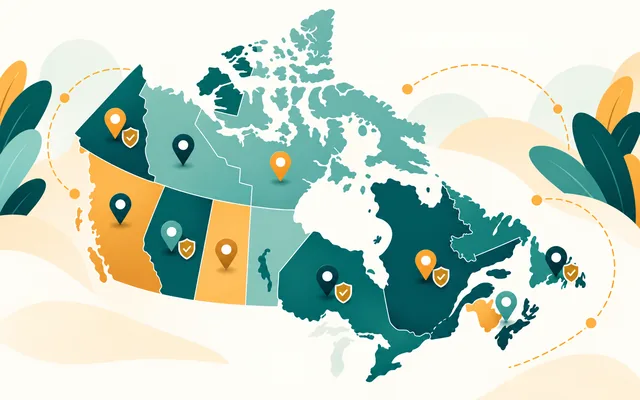
Canada does not have one answer to this question. Gaming is conducted and managed province by province, so the lawful way to play in Toronto is not the lawful way to play in Halifax, and the age at which you may do it changes when you cross into Alberta. This page is the map rather than a ranking of brands.
By the OntarioCashout desk · checked October 19, 2026 · 19+ Ontario
In short: There is no national answer. Ontario is the only province with its own regulated private market, run by iGaming Ontario under the AGCO; everywhere else online play runs through a corporation the province owns. Your province sets the age, the lawful option and where a complaint can go.
Real money online casino Canada: there is no one national answer
Type real money online casino Canada into a search box and the results behave as though the country ran on a single rule book. It does not. Gaming here is conducted and managed by the provinces, which means the lawful route in Ontario is not the lawful route in Nova Scotia, and the minimum age shifts when you cross into Alberta. None of this is hidden or obscure. It is simply never the shape a comparison page takes, because a national row of logos is far easier to publish than a map of thirteen different arrangements.
So this page is the map. It sets out who writes the rules in each province, who actually operates the market there, what age applies, which currency and payment routes you will run into, how a recreational player's winnings are generally treated for tax, and what becomes of a complaint when the company holding your balance answers to no authority where you live. That last point is worth reading twice, because it is the only question here whose honest answer can be nothing at all.
Two features make the Canadian picture unusual among English-speaking markets. One province opened a regulated market to private companies and publishes a dated list of exactly who is in it. Every other province offers online play through a corporation it owns outright, which is a monopoly rather than a register. The two models hand a player completely different tools. Under the first you can confirm who your counterparty is in about a minute. Under the second there is a single lawful address and nothing to compare, because comparison was never part of the design. A site that cannot say which province it is answering for has not answered the question you asked.
Why asking whether online casinos are legal in Canada gets you nowhere
The federal Criminal Code treats gaming as prohibited and then carves out an exception: a province may conduct and manage a lottery scheme, including one operated on a computer, within its own boundaries. That single structural choice explains the whole market. Legality is not a national yes or no that applies from coast to coast. It is a devolved power, exercised thirteen different ways, with each province deciding for itself what it conducts, what it permits others to conduct on its behalf, and who may take part.
Which is why the question as usually asked has no answer. Is a real money casino Canada wide legal? The sentence does not contain enough information to resolve. The version that does resolve names a place: what is lawfully offered to someone sitting in Manitoba, and by whom? Now there is a specific body, a specific platform, a specific age and a specific complaints route. Everything useful on this page follows from swapping the national framing for the provincial one, and it is the single most valuable habit to pick up here.
There is a second reason the national framing misleads. Most of what you will read about Canadian online gambling is written about the offshore sites that have served the country for two decades, holding licences issued somewhere else entirely. The usual line is that playing at them is a grey area for the player. That framing quietly skips the part that matters: whether anyone in your province has any authority over the company, any obligation toward you, or any ability to act if the relationship goes wrong.
So the three questions to carry through the rest of this page are small and concrete. Who conducts online gaming where I am physically sitting? Am I inside the province whose market I am joining? What is the legal age there? Answer those and you have replaced an unanswerable national question with three answerable local ones, which is as close to a straight answer as this market gets.
Ontario is the exception: a regulated private market with a public list
Ontario did something no other province has done. It opened internet gaming to private companies under a two-part structure: the Alcohol and Gaming Commission of Ontario, the AGCO, registers operators and sets the standards they must meet, while iGaming Ontario, iGO, holds the market and the commercial agreements with the operators that go live. For a player the consequence is concrete rather than philosophical. There is a public, dated catalogue of who is permitted to offer gaming to people in the province, maintained by the public side of the arrangement.
The catalogue carries a date, and the date is the point. As at 2026-09-01 it listed 49 operators and 84 gaming sites. Those numbers move as companies enter and leave, which is exactly why no third party should be quoting them to you as a current fact without saying when they were read. Our walkthrough of the Ontario registry explains what each entry contains, why a brand name and the legal entity in the footer are often different, and what it means when a name simply is not there.
Two conditions attach to the Ontario market and both are easy to state. You must be physically in Ontario to play on it, which is enforced by location checks rather than by an address on file. And the minimum age is 19, not 18, a detail that catches people who have read material written for other jurisdictions. Our page on playing at a real money casino Ontario deals with the province on its own terms, including what registration does and does not promise.
One thing worth being clear about: registration is not an endorsement and not a performance guarantee. It means a company met the registration requirements and agreed to operate under Ontario's standards, which cover advertising, player funds, game and system requirements, responsible gambling measures and complaint handling. It does not promise quick payouts, generous terms or pleasant support. Those you still have to assess yourself, and the criteria for doing so sit on our page about building a top Canadian casino online shortlist.
Nothing here says any named operator is registered in Ontario today; the catalogue is public and dated, and reading it on the day you intend to deposit is the only version of that check that is worth anything.
Outside Ontario the rules come from a provincial body, and they are not the same body.
Everywhere else: provincial monopolies, not registers
Outside the Ontario private market the model is older and structurally different. Each province offers online gaming through a corporation it owns, and that corporation is both the regulator's creature and the operator. Quebec has Loto-Quebec. British Columbia has BCLC. Alberta runs PlayAlberta through the AGLC. Manitoba works through its own liquor and lotteries corporation, the four Atlantic provinces through the Atlantic Lottery Corporation, and Saskatchewan through its own provincial arrangement. These are platforms, not lists of approved private companies.
Ontario sits in both camps at once, which confuses a lot of writing about the market. OLG.ca is not part of the iGO market. It operates under OLG's own conduct and management, as the provincial corporation always did, while the private registered sites operate under agreements with iGO. An Ontario resident therefore has two distinct lawful models available, with different complaint routes, and the fact that both are lawful in the same province does not make them the same thing.
In practice the monopoly model trades choice for certainty. There is no shopping around, no competitive bonus market and usually a narrower game lobby than a private operator would carry. What you get instead is a counterparty that is a provincial crown corporation, answerable through provincial channels, with no question about who it is or whether it will still be there next year. For a lot of players that trade is a straightforward win, and it rarely gets described fairly by sites whose business is comparison.
It also changes what a dispute looks like before it even starts. With a provincial corporation you are dealing with a body inside your own jurisdiction, subject to provincial oversight, with a published complaints process and an accountable owner. With an offshore site you are dealing with a company that your province did not licence, did not register and cannot instruct. Same money, same screen, entirely different footing, and the difference only becomes visible on the day something goes wrong.
Province by province: who runs the market, the age, what it means
The table below is the short version of everything above. Read your own row first, then read Ontario's, because almost all English-language writing about Canadian online casinos is written for Ontario without saying so. If the two rows differ, the page you were reading before this one was probably describing somebody else's province, including its age limit and its complaint route.
A note on how to use the last column. It is not a verdict on whether to play; it is a description of the position you are in when you do. The practical weight of each row lands at two moments, when you choose where to deposit and when you need somebody to take a complaint seriously. Everything in between, the games, the interface, the promotions, is the same software on either side of the line.
Who sets the rules, who runs online play, the minimum age, and what it means for a player
Province or territory
Who regulates or runs online play
Minimum age
What it means for you
Ontario
AGCO registers operators and sets standards; iGaming Ontario holds the private market; OLG runs OLG.ca separately
19
Two lawful models, and a dated public catalogue you can search before depositing
Quebec
Loto-Quebec, as the provincial corporation
18
One provincial platform is the lawful option; no register of private operators to consult
British Columbia
BCLC, as the provincial corporation
19
Provincial platform only; a complaint goes to the corporation that runs the site
Alberta
AGLC, through the PlayAlberta platform
18
Provincial platform only, with one of the country's lower age thresholds
Manitoba
The provincial liquor and lotteries corporation
18
One provincial platform; a private site answers to no Manitoba body
Saskatchewan
The province's own lottery and gaming arrangement
19
Provincial platform only; nothing to look up, because there is no list
New Brunswick, Nova Scotia, Prince Edward Island, Newfoundland and Labrador
Atlantic Lottery Corporation, on behalf of the four provinces
19
A shared regional platform; escalation runs through the corporation and the province
Yukon, Northwest Territories, Nunavut
Territorial arrangements through the regional lottery bodies
19
Thin local provision; the register check available in Ontario does not apply to you
The legal age is 19 in Ontario and 18 in three provinces
Age is the detail that trips up the most readers, because the gambling internet is written largely in American and European English, where 18 and 21 are the familiar numbers. In Canada the age for online gaming follows the province. It is 19 in Ontario, British Columbia, Saskatchewan, the four Atlantic provinces and the three territories. It is 18 in Alberta, Manitoba and Quebec. There is no national minimum, because there is no national market for one to attach to.
This matters more than a line in a terms document suggests. Age is verified against identity documents, and it is verified properly at some point in the relationship, usually when money is leaving rather than when it is arriving. An account opened under the age that applies where you are is not a technicality that quietly resolves itself later. It is the kind of problem that surfaces at a payout, with the balance in the middle of it and no good options on either side.
A second complication arrives with movement. The age that applies is the age of the province whose market you are in, not the age of the province you grew up in. An 18-year-old in Alberta is of age for PlayAlberta. The same person physically in Ontario is not of age for Ontario's market, and the gap between provincial thresholds is not a loophole to work with. It is simply two different rules that happen to meet at a border.
19 applies in Ontario, British Columbia, Saskatchewan, the Atlantic provinces and the territories.
18 applies in Alberta, Manitoba and Quebec.
The age that counts is the one in force where you are physically playing, not where you are from.
Verification against documents usually lands at the first withdrawal, which is the worst moment to discover a mismatch.
Age, name and payment-instrument details all have to agree, so fix any discrepancy when you register.
What the two models mean when you are actually choosing
Put the structure aside for a moment and look at the decision in front of you. If you are in Ontario, you have a field of registered operators to choose between and a way to confirm that any one of them belongs in that field. The work is comparison: thresholds, routes, terms, support, limit tools. The counterparty question is answerable before you spend anything, so your effort goes into the quality questions that sit on top of it.
If you are anywhere else, the shape of the decision inverts. There is one lawful provincial platform, so there is nothing to compare within the regulated option, and every alternative you are being shown sits outside your province's reach. The work is no longer comparison, it is deciding what you are prepared to accept from a counterparty nobody local can hold to anything. That is a judgement about risk, and it is entirely yours to make.
What does not change across the country is the money. Canadian banking behaves the same way in Victoria as in St John's, which is why Interac routes dominate deposits nationally and why bank-side crediting times look similar everywhere. Operator-set details travel too: cashier minimums, payout thresholds, the documents requested at verification, the way bonus conditions are written. So the quality checks are portable even where the register check is not.
Which gives a reasonable rule for reading any Canadian casino page, including this one. Separate the claims that depend on your province, legality, age, who is accountable, where a complaint goes, from the claims that do not, payment routes, thresholds, terms, software. Most pages mix the two freely and leave you to untangle them. Once you have sorted them yourself, a national ranking becomes easy to use for the part it is actually good at.
Currency: a CAD account against conversion at every step
For a Canadian real money casino account the currency setting is a quiet, compounding cost that almost nobody checks before depositing. If the account is denominated in Canadian dollars and your bank account is too, money moves without an exchange step, the figures on the cashier page match the figures on your statement, and the minimums quoted in dollars are the minimums you actually face. If the account is in another currency, every single movement crosses a conversion, and conversions are rarely free.
The cost is not usually one large fee. It is a series of small ones with different owners: a rate spread on the way in, a rate spread on the way out, possibly a card issuer's foreign transaction charge, and the drift between the two rates in the time your balance sat there. Each looks negligible on a single transaction. Over a dozen deposits and a handful of payouts the total stops being negligible, and it never appears on any page describing the operator.
So set the currency when you open the account, not later. Many operators fix it at registration and will not change it afterwards, which turns a thirty-second choice into a permanent condition. The table below lists the points at which conversion shows up, so you can check each one on the operator's own cashier rather than taking a guess at the total.
Where a non-CAD account costs you something, and what to confirm first
Step
What happens if the account is not in Canadian dollars
What to confirm before you deposit
Deposit
Your bank or card converts, at its own rate, with a possible foreign transaction fee
Whether CAD is offered as an account currency at registration
Thresholds
Minimums and bonus qualifying amounts are stated in the other currency
The deposit and withdrawal minimums as they appear in your account currency
Stake limits
A maximum stake during bonus play converts to an odd figure that is easy to breach
The maximum bet clause, in the currency your stakes are actually placed in
Balance held
The value drifts with the rate while the money is sitting in the account
Whether you can withdraw in the same currency you deposited
Withdrawal
A second conversion on the way out, plus any route-specific fee
The payout routes available in your province and their stated fees
Records
Statement amounts never match cashier amounts, which makes any dispute harder to argue
That the cashier gives you a dated transaction history you can export or screenshot
Canadian payment routes, and what they tell you about an operator
The payment side is where a site reveals whether it was built for this country or merely translated into it. Canadian players fund accounts mostly through bank rails, not cards, and the names are specific: Interac, Interac e-Transfer, InstaDebit, with wallets and prepaid vouchers filling the gaps. An operator carrying a proper set of Canadian routes has done the processing work for this market. One offering only international cards and crypto has not, whatever the maple leaf in the header suggests.
Each route behaves differently, and the differences matter more than the logos. Interac moves money straight from the bank account you already hold, with no new relationship to set up. Interac e-Transfer sends between accounts using an email address or phone number, which makes the name and contact details on file worth checking. InstaDebit sits between your bank and the operator, so the casino never sees the bank credentials. Our payment methods page compares them properly, and the mechanics of Interac e-Transfer have a page of their own.
The check almost everyone skips is whether a route works in both directions. Deposit lists are marketing and payout lists are operations, which is why the second is shorter. Most operators also return funds by the route they arrived on, so the method you fund with quietly sets the terms of your eventual payout. A prepaid voucher cannot receive money at all, and discovering that after a win means accepting whatever fallback the operator picks for you.
One route detail is specific to the provincial question. Payment availability is filtered by where you are, so the authoritative method list is always the cashier page inside your own logged-in account, not a comparison table written for the country as a whole, including this one.
Confirm at least one route that works for deposits and for withdrawals in your province.
Expect funds to return by the route they arrived on, and choose the deposit method accordingly.
Check the name on the bank account, wallet or e-Transfer contact matches the account name exactly.
Note the withdrawal minimum and any per-transaction or monthly ceiling before you fund anything.
Keep a prepaid voucher for capping spend, not for getting paid, since it cannot receive money.
Tax on winnings: the general rule, and the exception that is not you
The usual Canadian position is that a recreational player's gambling winnings are not treated as income and are not reported as such. The reasoning is that a windfall from a game of chance is not income from a source in the ordinary sense: there is no business, no employment and no property producing it. That is why most Canadians who have ever won anything have never filed a thing about it, and why the question feels strange to people who have read American material on the subject.
The exception is the one people quote without checking what it requires. Income from gambling carried on as a business can be taxable, and the test is about the whole character of the activity: whether it is organised and systematic, whether it is conducted with a reasonable expectation of profit, how it is funded, how records are kept, and whether the person relies on it. This is a narrow and fact-specific question that lands on a small number of people, and if you have arrived here from a search about casino bonuses, you are almost certainly not one of them.
None of the above is tax advice, and nothing on a casino page should be read as a substitute for it. It is a sketch of the general framework so that you can recognise which questions are yours and which are not. If any part of your situation looks like the exception rather than the rule, or if a foreign jurisdiction withheld something at source, that is a conversation to have with an accountant and with the Canada Revenue Agency's own material, not with a comparison site.
What changes when you move province, or travel for a week
Because the market is provincial, moving is not an administrative footnote. Access to a provincial platform is tied to the province that runs it, and the Ontario private market is built for people physically in Ontario. Change your province of residence and the account you have been using may no longer be the account that is lawfully available to you, which means withdrawing the balance, closing the account properly and opening the right one in the new province, in that order.
The practical sequence is worth planning before the move rather than after. Withdraw the balance while your verified details still match the province on file. Save the transaction history and any support correspondence, because a closed account's records are much harder to retrieve than an open one's. Expect verification to be requested again at the new platform, since documents do not transfer between operators, and expect new payment routes, because availability is set province by province and your old method may not appear.
Travel is a smaller version of the same thing and often surprises people more. Location checks read where you are at that moment, not where you live, so a week in Montreal can mean an Ontario account simply will not load, and a week in Toronto can mean the reverse. Nothing is broken and nothing has been taken away. The market you joined is defined by a place, and you are temporarily not in it.
To be direct about one thing: this page will not tell you how to appear to be somewhere you are not. Working around a location check breaches the operator's terms, and the predictable consequence is a frozen account with a verified balance inside it, at the precise moment you want to withdraw. If you spend meaningful time in two provinces, the clean answer is to use the platform that is lawful where you actually are and to keep the two relationships separate.
Where a dispute goes, and where it goes nowhere
This is the section that justifies the rest of the page, so here is the conclusion first. If an operator is neither in Ontario's public catalogue nor the provincial corporation where you live, there is no Canadian body with authority over your complaint. Not a regulator, not an ombudsman, not a provincial ministry. The escalation path ends at the operator's own support desk, and if the operator chooses to stop replying, that is where the matter stops.
Compare the two regulated routes. Inside the Ontario market an operator is registered by the AGCO and operating under standards that cover complaint handling, with a route that continues past the operator when its internal process fails. With a provincial corporation you are dealing with a crown entity inside your own jurisdiction, with a published process, provincial oversight and an owner that is ultimately accountable to the legislature. Neither guarantees you win an argument. Both guarantee somebody is obliged to hear it.
Outside those routes, the usual substitutes are weaker than they look. A foreign licence means the authority that issued it is in another country, working in its own language and timeframes, with no obligation to a Canadian player and no instrument to use in Canada. An independent dispute service listed on the operator's own footer may be genuine and may be decorative; it is appointed by the operator, and the only way to know which it is involves needing it. A chargeback is a bank mechanism with tight windows and little sympathy for gambling transactions, not a complaints process.
Which turns the whole page into one practical instruction. Before you deposit, write down the answer to a single question: if this operator stops paying me, who do I contact, and what are they obliged to do? If you can name a body and a published process, you have a counterparty with somebody standing behind it. If you cannot, you are holding a receipt and an email address, and no rating, review count or payout claim changes that arithmetic.
Ontario private market: registered by the AGCO, with a complaint route that continues past the operator.
Provincial corporation: a crown counterparty in your own jurisdiction, with provincial oversight.
Offshore licence: a foreign authority with no obligation to you and no reach into Canada.
Operator-appointed dispute service: possibly useful, chosen by the other side, verifiable only when it matters.
Chargeback: a bank tool with strict deadlines, not a gambling complaints mechanism.
Self-exclusion and help: BetGuard, ConnexOntario and provincial services
The support side of this market is also provincial, which means the right phone number depends on where you are. In Ontario, ConnexOntario provides free and confidential information and referral for gambling, mental health and substance use concerns, around the clock, and it is a provincial service rather than anything connected to an operator. Every other province funds its own problem gambling helpline and treatment referral service, usually through its health ministry or its gaming corporation.
Ontario also has a single tool that no other province matches. BetGuard, at betguard.ca, launched on 2026-05-14 as one central self-exclusion portal: one request blocks access across all of the province's regulated gaming sites, including OLG, for a term starting at six months. Before it existed, a player had to exclude themselves site by site and hope none was missed. One action now covers the regulated market, which is a real improvement and also the limit of its reach.
That limit is worth stating plainly, because it is the same boundary the rest of this page keeps running into. BetGuard covers Ontario's regulated market. A site outside that market is outside the block, and a self-exclusion is only as effective as the set of sites it reaches. iGO has also warned about imitation sites set up to look like BetGuard, so type the address by hand rather than following a search result or a link somebody sent you.
The one warning this page needs sits here rather than repeated in every section. Gambling is paid entertainment with a negative expected return, and no amount of research into provincial structures changes that. Play at the legal age where you are, with money whose loss changes nothing you depend on, and set the deposit and loss limits in your account at the start rather than in a bad moment. Our responsible gambling page collects the provincial services and the account-level tools in one place.
If play has stopped being entertainment, ConnexOntario answers at any hour in Ontario, every other province runs its own service, and in Ontario a single BetGuard request covers the whole regulated market at once.
Before you deposit: the provincial checklist
Everything on this page reduces to a short list of things to establish before any money moves. None of it takes long, none of it needs expertise, and all of it is published somewhere you can read. The point of running through it is not caution for its own sake; it is that each item is cheap to check in advance and expensive to discover afterwards, which is the only test a checklist really has to pass.
Do it in order, because the early items change the value of the later ones. There is no sense comparing bonus terms before you know whether anyone in your province can hold the operator to anything.
Finally, date your answers. Catalogue entries change, payment routes change, terms change and the figures in this page's own tables were read on a particular day. A check you ran in March is a historical note by October. Before any deposit large enough that losing access to it would annoy you, run the first three items again. That is five minutes against the only loss on this page that research can actually prevent.
Identify which province's rules apply to you, and read that row of the table rather than Ontario's by default.
If you are in Ontario, search the dated public catalogue for both the brand and the legal entity in the site's terms.
If you are elsewhere, be clear whether you are joining the provincial platform or accepting an operator with no local accountability.
Confirm the legal age where you are, and that your account details and documents match it exactly.
Set the account currency to CAD at registration if the option exists, since it often cannot be changed later.
Check one payment route that works in both directions in your province, plus the withdrawal minimum and any ceiling.
Write down who you would contact if payments stopped, and what they would be obliged to do about it.
What we can state about 22BET, and what stays yours to check
This site works with 22BET, and the disclosure stays short because the verifiable part is short: a five-star rating and 4 889 reviews, confirmed by the owner of this site and labelled for what it is. A rating and a review count say something about how people felt about a product. Neither of them answers a provincial question, so neither belongs in the same column as accountability, age or jurisdiction.
Nothing here asserts that 22BET or any other operator appears in Ontario's catalogue today. That information is published, dated and maintained by the public side of the Ontario market, and it changes. The check belongs to you and takes about a minute on the day it matters, which is the day you intend to deposit rather than the day you first read a page about it. The Ontario registry walkthrough explains how to run it and how to read what you find.
The operational detail is deliberately left where it is current. Deposit and withdrawal routes, minimum amounts, limits, fees, processing windows and whatever bonus conditions are live this week all sit on the operator's own cashier and terms pages, behind a login, filtered for where you are. Check them there. Any figure quoted by a third party, this site included, is a snapshot of a page that may have changed since, and a stale number is worse than no number.
So use this page for the part a brand page cannot give you. Work out which province you are in, what that means for who is accountable to you, what age and currency apply, which routes move money in both directions, and where a complaint would actually go. Then pick an operator with the ordinary quality checks, whether that is our partner, a registered Ontario site or your provincial platform. The structure comes first; the shortlist is the easy part afterwards. If you want the games side of the same decision, our page on online slots real money Canada covers what changes once the money is real.
19+ in Ontario, 18+ in Alberta, Manitoba and Quebec. The rating shown here is the operator rating reported by the site owner on 19 October 2026: five stars from 4,889 reviews. Availability depends on where you are and on eligibility. Deposit routes, cashout timing, verification steps, offer structure, wagering and limits are set by the operator and are not stated here — read them in the cashier and in the current terms after you sign in. We do not guarantee payout speed or availability in your province. Gambling costs money; treat any balance as spent. Checked: 19 October 2026.
Questions people actually search
Is a real money online casino legal in Canada?
There is no national answer, because gaming is conducted and managed province by province. Ontario runs a regulated private market alongside OLG, and every other province offers online play through its own corporation, so what is lawfully available to you depends on where you are physically sitting.
Which Canadian province has regulated online casinos?
Ontario is the only one with its own regulated private market, where the AGCO registers operators and iGaming Ontario holds the market. The public catalogue listed 49 operators and 84 gaming sites as at 2026-09-01, and you have to be physically in Ontario to play on it.
How old do you have to be to gamble online in Canada?
It depends on the province. The minimum is 19 in Ontario, British Columbia, Saskatchewan, the Atlantic provinces and the territories, and 18 in Alberta, Manitoba and Quebec. The age that applies is the one in force where you are playing, not where you grew up.
Can I use an Ontario casino account from another province?
Ontario's regulated market is built for people physically in Ontario and operators apply location checks accordingly, so an account can simply refuse to load elsewhere. Other provinces offer their own platforms instead, and working around a location check breaches the operator's terms and risks the balance.
Are gambling winnings taxable anywhere in Canada?
As a general rule a recreational player's winnings are not treated as income in Canada, while income from gambling carried on as a business can be. Interest or gains earned on money you won are ordinary investment income. This is a sketch of the framework, not tax advice.
Should my casino account be in Canadian dollars?
If your bank account is in CAD, yes, because every movement in another currency crosses a conversion on the way in and again on the way out, and the stated minimums and stake limits stop matching your statement. Many operators fix the currency at registration and will not change it later.
Who do I complain to about an online casino in Canada?
If the operator is registered in Ontario or is your provincial corporation, there is a published process and a body obliged to hear you. If it is neither, no Canadian authority has jurisdiction, the escalation path ends at the operator's own support desk, and that is the main reason to settle this question before depositing.
Checked by the OntarioCashout desk.
Operator terms change without notice: read the cashier and the current terms at 22BET before you
rely on anything here. Open 22BET.

 5.0 stars from 4,889 reviews