19+ in Ontario, 18+ in Alberta, Manitoba and Quebec. The rating shown here is the operator rating reported by the site owner on 19 October 2026: five stars from 4,889 reviews. Availability depends on where you are and on eligibility. Deposit routes, cashout timing, verification steps, offer structure, wagering and limits are set by the operator and are not stated here — read them in the cashier and in the current terms after you sign in. We do not guarantee payout speed or availability in your province. Gambling costs money; treat any balance as spent. Checked: 19 October 2026.
Most pages about casino payment methods hand you a grid of logos and leave you to guess. This one maps every route a player in Ontario or the rest of Canada can realistically use, in both directions, and names the company that owns the waiting at each step. Some routes carry money in and back out again. Some only go one way, and finding that out after you have already deposited is the expensive way to learn it.
By the OntarioCashout desk · checked October 19, 2026 · 19+ Ontario
In short: Canadian players have about nine usable routes. Interac, InstaDebit, MuchBetter, bank transfer and most debit cards move money both ways; Paysafecard, Apple Pay and Google Pay generally only move it in. The delay belongs to your bank, to an intermediary, or to the operator.
Why casino payment methods need a map rather than a list
Lists of casino payment methods are easy to produce and almost useless to read. A logo tells you that a route exists somewhere in the market; it does not tell you whether that route runs in both directions, whether it exists for your account specifically, which company will be holding your money when the screen says nothing is happening, or what has to be true about your name and your documents before the route works at all. Those four facts decide your experience. The logo decides nothing.
This page is the hub for the rest of the payments section. It covers the nine routes a Canadian player is actually likely to meet: Interac Online and Interac Debit, Interac e-Transfer, InstaDebit, MuchBetter, Paysafecard, Visa and Mastercard in their credit and debit forms, ordinary bank transfer, and the phone wallets Apple Pay and Google Pay. Each one gets a short, honest paragraph here and a link to its own page, because the mechanics of each deserve more room than a hub can give them.
What the hub adds that a single-method page cannot is the comparison. Read nine separate pages and you learn nine sets of mechanics without ever seeing the pattern. Read them side by side on a few axes — does it come back, who verifies you, where the minimum comes from, what breaks on a name mismatch — and the choice resolves itself in about a minute. That is the work this page is doing, and it is the reason it exists before the ones it links to.
Three owners sit on every route, and only one of them is the operator
Pick any route in the cashier and you have quietly hired up to three organisations. Your own financial institution sits at one end, because the money starts in or returns to an account it controls. The operator sits at the other end, because it runs the balance you are funding and the review desk that signs off on anything leaving it. And on several routes there is a third party in between: a wallet, a bank-linked service, a voucher network or a card scheme, each with its own rules about who you are and what you may move.
Delay belongs to whichever of those three is holding the instruction right now, and that is almost never the one you are complaining to. A deposit that hangs on a bank sign-in screen is your institution's business. A payout that sits labelled as pending for a day and a half is the operator's review desk. Money that reached a wallet balance and stopped there is the wallet's problem, and the wallet has never heard of the casino's terms.
The useful habit is to name the owner before you do anything else. Where is the instruction, and who is holding it? If it has not left your bank, the casino cannot help. If the operator has released it and your balance has not moved, the operator genuinely cannot do anything more either. If there is an intermediary in the path, there is a whole second set of terms that nobody showed you at the cashier, and that is where a surprising share of stalled money turns out to be resting.
The axes that separate casino payment options
Every genuine difference between casino payment options collapses into a small number of questions. Learn these and you can read any new method you meet in this market without needing a guide written about it. They are deliberately not about speed, because speed is an output of the others rather than a property you can select.
The first axis is direction. Does the route carry money back out, or only in? One-way routes are not defective, they are simply incomplete, and planning for them means deciding in advance where the money will come back to instead. The second is verification: who has to be satisfied that you are you. Sometimes it is only the operator. Sometimes an intermediary runs its own check on its own schedule, and that check is completely invisible from the casino's cashier.
The third is where the minimum lives, because the smallest amount you can move is frequently set by a company other than the casino. The fourth is name matching: what happens when the name on the funding instrument does not exactly match the name on the gaming account. On some routes that is a minor annoyance. On others it is a hard stop that only a document can resolve. Each axis gets its own section below, and all of them appear in the comparison table.
Direction — whether the route is round trip or one way, and if one way, which route the money is going to have to come back on instead.
Verification — whether only the operator checks you, or whether a wallet, bank-linked service or card issuer runs a separate check on its own calendar.
Minimum and fees — which of the three owners sets the floor and which of them is quietly billing you, since more than one can bill the same transaction.
Name matching — whether the route can tolerate a middle name, a maiden name or a joint account, or whether a mismatch stops it dead.
Visibility — whether you get a notification and a status you can refresh, or a reference number followed by silence until the money appears.
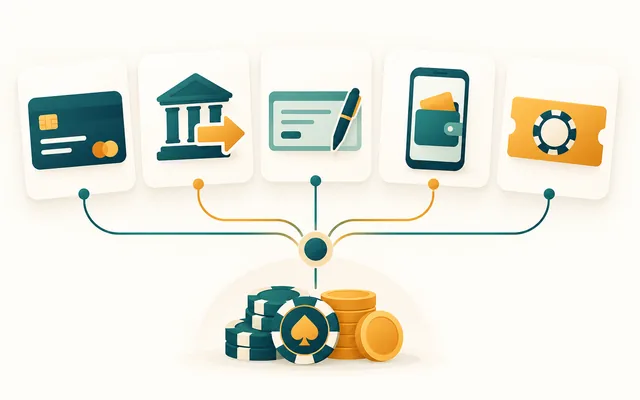
Five routes, three different owners of the delay: your bank, the wallet, the operator.
The full route map: in, out, who holds the delay, what gets checked
What follows is the core of the page. Read it as a map of responsibility rather than a leaderboard, because none of these routes is the best one in general and several are the best one for a specific task. The direction columns describe the usual arrangement across the market, not a promise about any single operator: a cashier can offer a route for deposits only even when the route itself is perfectly capable of carrying a payout, and that decision belongs to the operator.
The delay column is the one worth lingering on. Notice how often it names your own institution or an intermediary rather than the casino, and notice that the operator's review desk appears in every row that carries money out. That is the structural reason payout timing varies so little between routes compared with how much it varies between accounts. Choosing a route changes the last leg. Finishing your verification changes the longest one.
The checks column is the practical one. It tells you what you can clear in advance, which is the only part of the whole picture that is genuinely in your hands. Everything in that column can be dealt with on a quiet afternoon rather than on the day you want your money.
Canadian casino payment methods: direction, delay ownership and checks
Route
Carries deposits
Carries withdrawals
Who holds the delay
What gets checked
Interac Online and Interac Debit
Yes, pushed from your chequing account through your own bank's sign-in
Rarely under the same name: payouts in the Interac family usually come back as an e-Transfer
Your financial institution during the sign-in step, then the operator's review desk on the way back
That the bank account is one you can sign in to; the account holder's name is matched before any payout
Interac e-Transfer
Yes, as a transfer you send from online banking to an address the cashier gives you
Yes, and it is the usual return path for anything that started in the Interac family
Your bank at the send and accept steps, and the operator's review desk before release
The receiving address is one you control, the bank account name matches, and any security question is answerable
InstaDebit
Yes, through a service that links to your bank account on your behalf
Yes, back to the same linked bank account
InstaDebit's own setup and checks on first use, then the operator's review desk
Your identity and bank ownership at the service, separately from whatever the operator asks for
MuchBetter
Yes, from a wallet balance you have already topped up
Yes, into the wallet balance, which is not the same thing as into your bank
The wallet at its own verification thresholds, and again on the onward hop from wallet to bank or card
Wallet identity must line up with gaming account identity; the wallet may run its own check at a threshold it sets
Paysafecard
Yes, using a voucher code bought with cash or card at retail
No in the ordinary case: a voucher is one-way and the operator pays you back some other way
Nobody once the code is accepted, which is the point; the delay moves to your replacement payout route
Almost nothing at the voucher step, which is exactly why the operator's checks land later and harder
Visa or Mastercard credit card
Sometimes: Canadian issuers decline gambling transactions or treat them as cash advances at their own discretion
Sometimes, as a credit pushed back along the authorisation path, and some issuers do not accept it
Your card issuer, both at the decline decision going in and at the posting decision coming back
The cardholder name against the gaming account, and the card still being valid rather than reissued with a new number
Visa Debit or Debit Mastercard
Usually, since the funds come from your chequing account rather than from a credit line
Often, though a reissued or replaced card can break the return path without warning
Your bank and the card scheme going in, your bank's posting schedule coming back
Same name matching as a credit card, plus whether the specific product accepts incoming credits at all
Bank transfer and EFT
Yes, though the fee and the paperwork make it a poor fit for small amounts
Yes, and it is the usual route for large sums and for the awkward cases
The banking system's settlement batches and business calendar, plus the operator's review desk
Account details lodged correctly, and an account in your own legal name rather than a shared or business one
Apple Pay and Google Pay
Sometimes, where offered, acting as a wrapper over a card or bank account already added to the phone
No as a rule: the phone wallet is a way to present a card, not a destination money can be sent to
Whatever instrument sits underneath, since the phone adds authentication rather than a new rail
The device check satisfies the phone, not the operator; the underlying card's name is what the operator matches
Interac: one name, two quite different routes
Interac is the backbone of Canadian online casino banking methods, and the single most common source of confusion, because one brand covers two mechanisms that behave nothing alike. One is a direct bank payment: you are handed to your own institution's sign-in screen, you authorise a push from your chequing account, and you come back to the cashier with the funds already credited. The other is a transfer you send yourself from online banking to an address the cashier supplies, which arrives when it arrives.
The direct version feels like a card payment and is not one. There is no card scheme, no credit line and no issuer with a policy about gambling, which removes the most common reason a Canadian deposit gets declined. What it adds instead is a dependency on your bank's own online banking being available and on your institution participating in the first place, which is a shorter list than people assume. The mechanics of that handoff, and which banks are usually in it, belong on the Interac casinos page.
The transfer version is the one that usually brings money back, and it has a step that sits entirely on your side: accepting the incoming transfer, possibly by answering a security question you were never told in advance. That sequence is taken apart properly on the Interac e-Transfer page. If you want to know which operators list the route at all, the casinos that accept Interac page covers the acceptance question, and the best Interac casinos page ranks them on how well they handle it. Expect to deposit through one Interac mechanism and be paid back through the other, with the cashier calling both simply Interac.
The middle layer: InstaDebit, MuchBetter and Paysafecard
Three routes work by putting a company between you and the operator, each for a different reason, and in every case you have added a set of terms the casino cannot interpret for you. InstaDebit links to your bank account and moves money on your behalf, which makes it the closest thing to a round-trip bank route with a consumer interface in front of it. The trade is a setup process on first use: the service verifies you and verifies that the account is yours before it will do anything. Done in advance, that is a one-off afternoon. Done on the day you wanted to deposit, it is the reason the deposit did not happen.
MuchBetter is a wallet, which means the balance lives at the wallet rather than at your bank. For deposits that is simply a top-up question. For payouts it is the structural point most people miss: money arriving in a wallet has arrived somewhere, but not necessarily where you wanted it, and the hop from wallet to chequing account is a separate journey with its own rules. The wallet may also run its own identity check at a threshold it chooses, on a schedule the casino has no visibility into.
Paysafecard is a different animal entirely: a prepaid voucher bought at retail, usually with cash. It asks almost nothing of you at the point of use, which is precisely its appeal, and it is the only mainstream route on this page that does not require a bank relationship to fund a deposit. The cost is directional. A voucher is a one-way instrument, so the moment you have a balance worth withdrawing you need a second route you have not yet set up, and the operator's checks all arrive at once at that point.
Cards: Visa, Mastercard and the issuer's quiet veto
Cards look like the obvious default and are the least predictable route in the Canadian market. The reason is that a card transaction involves a company with its own policy that nobody consults you about. Your issuer decides, transaction by transaction, whether to approve a payment coded as gambling, and Canadian issuers vary enormously: some approve routinely, some decline flatly, and some approve while treating the amount as a cash advance, which changes how interest is charged from the moment the transaction posts.
The return leg has its own structure. A payout to a card is not a transfer, it is a credit pushed back along the authorisation path, which means it has to be accepted and posted by your issuer before you see it. Some card products accept incoming credits of that kind and some do not. Prepaid cards are frequently excluded outright, and a card reissued with a new number since your deposit may no longer be a valid destination at all, which turns a routine payout into a manual case.
Debit cards branded Visa Debit or Debit Mastercard sit in between and are generally the better half of the card family for this purpose. The money comes from your chequing account rather than a credit line, so the cash-advance question disappears and the gambling-decline question is less frequent. What stays is the name matching and the reissue risk. If you intend to use a card at all, a debit product in your own name is the version of this route that breaks least often.
Bank transfer, EFT and the phone wallets
A direct transfer to or from a bank account is the oldest route in any cashier and the one with the fewest eligibility surprises. Nothing about it is clever, which is its virtue: money goes from an account in your name into the operator's banking arrangement and back again, with no intermediary holding a balance and no scheme deciding whether gambling is permissible. For large sums and for awkward cases where other routes have already failed, this is usually what the operator will fall back on anyway.
The cost is a calendar. The banking system moves this traffic in collected settlement batches rather than as individual instant pushes, and those batches follow business days that ignore your weekend. A transfer released just after a cut-off waits for the next window, and nothing has gone wrong. Transfers also give you a reference number and then silence, with no notification step and no status to refresh, which makes an ordinary wait feel longer than it is.
Apple Pay and Google Pay belong in this section because of what they are not. Neither is a rail. Each is a wrapper that presents a card or bank account you have already added to your phone, with the device handling authentication so you do not type a number. That makes a deposit genuinely quicker and slightly safer to key in, but it does not create a destination money can be sent to, which is why these wallets appear on deposit tabs and almost never on withdrawal tabs. Everything downstream is governed by the card underneath, not by the phone.
Why your withdrawal route usually has to match your deposit route
Almost every operator in this market applies some version of a closed-loop rule: money leaves by the door it came in through. Players tend to read that as an obstacle invented to slow payouts down, and it is worth understanding properly, because it is not arbitrary and it cannot usually be negotiated away. It exists because sending funds back to the instrument that funded an account is the simplest available proof that the money is going to the person it came from, and it works without anyone having to investigate.
What this means in practice is that your first deposit quietly decides your payout route. Choose the route you want to be paid on, and use it for the deposit even if a different one would have been marginally easier that day. A player who deposits by voucher because it was convenient and then wants a bank payout has not done anything wrong, but they have scheduled a verification conversation for the least convenient possible moment, which is immediately after a win.
The rule also has limits and exceptions, and they are specific rather than general. Deposits larger than the eventual payout, closed accounts at the receiving end, routes the operator has since stopped offering, and genuinely one-way instruments all force a departure from the loop. In each case the operator substitutes the nearest verifiable alternative, which in Canada is nearly always an e-Transfer or a bank transfer into an account in exactly your name.
One-way routes: what to do when the money cannot come back the same way
Three routes on the map are effectively one way. Paysafecard is a voucher, so there is nothing to credit back. Apple Pay and Google Pay are wrappers, so there is no account to send to. Credit cards are a partial case, since the return path exists in principle but your issuer may simply not accept it. In all of these, the deposit works beautifully and the problem is deferred to the point where you have money to collect.
Deferred is not the same as avoided, and the deferral is the trap. The replacement route has to be set up, verified and matched to your name at the exact moment you least want to deal with paperwork. If the substitute is an e-Transfer, your bank account name has to match. If it is a bank transfer, account details have to be lodged correctly the first time, since a rejected transfer sends the whole request back to the start. None of that is difficult. All of it is slow when done under pressure.
There is one honest reason to accept a one-way route anyway, and it deserves respect rather than a warning. If what you want is a hard ceiling on spending, a voucher bought for a fixed amount in cash is the most effective limit in this entire list, because you cannot spend what the instrument does not contain. That is a legitimate reason to put up with a clumsier payout path, provided you prepare the replacement destination before there is a balance attached to the question.
Before depositing on a one-way route, confirm in the withdrawal tab which routes your account can actually be paid on, since that list is shorter than the deposit list.
Set up the replacement destination first: for an e-Transfer, an address you can open; for a bank transfer, details you have checked character by character.
Make sure the replacement destination is in your own legal name, matching the gaming account, before any balance is sitting behind the question.
Finish identity verification while nothing is pending, so the substitution is a clerical change rather than a full review of a stranger's account.
Expect a one-way deposit to attract a closer look on the way out, because the operator has less to match against than it would on a round-trip route.
Name matching: the quiet reason routes break
Of all the ways a route fails, a mismatched name is the most common and the least discussed, and the mismatches are rarely dramatic. A registration made with a shortened first name while the bank account carries the full legal one. A middle name present on one side and absent on the other. A married name on the bank account and a maiden name on the gaming account, or the reverse. A joint chequing account where the first name listed is a spouse's. A wallet registered years ago under an old spelling nobody has corrected since.
The consequences differ by route, which is the part worth planning around. A deposit with a mismatch often goes through without comment, because money arriving is a smaller risk than money leaving, and that is precisely why the problem stays hidden until a payout. Third-party instruments are the hard stop: a card or an account in somebody else's name, including a family member's, is not usable regardless of who actually owns the funds, and that is one rule no operator in a regulated market will bend.
Fixing it is tedious rather than hard, and it has to happen on the gaming account side as often as on the banking side. Register with your name exactly as it appears on the identity document you will eventually upload, and make sure every instrument you intend to use carries that same name. Doing it at registration costs ten minutes of attention. Doing it later means a support ticket, a document upload and a payout standing still while both are read.
Minimums and fees: which of the three owners sets the number
The smallest amount you can move is almost never a single figure, because at least two of the three owners get a say and the higher one binds you. The operator configures a floor in its cashier software. The route carries its own, set by a bank, a card issuer, a voucher denomination or a wallet that has never heard of the casino. When they disagree, the transaction has to satisfy both, and the screen that rejected you tells you which layer complained if you read it rather than retrying.
Vouchers are the clearest illustration, because the floor is physical. You buy a fixed denomination at retail and that face value is the real minimum, regardless of what the cashier would have accepted. Wallets simply move the question upstream to whatever you loaded the wallet with. Bank transfers have no meaningful floor and a flat fee instead, which makes a small transfer poor value even where it is permitted. The full treatment of deposit floors lives on the minimum deposit page.
Fees follow the same pattern and catch people out in the same way, because more than one party can bill the same transaction. The operator may or may not charge. The intermediary usually has a schedule of its own, sometimes including a charge for the onward hop out of a wallet. Your own institution may add a transfer fee or, on a credit card treated as a cash advance, start charging interest from the posting date. Payout floors sit higher than deposit floors too, so plan the deposit with the eventual payout in mind.
Choosing casino payment methods for your actual task
The map only pays off when you stop asking which route is best and start asking what you are trying to do. Four tasks account for nearly every real question in this market, and each one points at a different part of the table. If the task is a small first deposit to look around, you want the route with the least setup and the lowest stakes, and you should accept that the payout route is a separate decision for later. If the task is a clean payout, you want a round-trip route into an account in your own name, with verification already finished.
If the task is keeping gambling off a shared bank or card statement, the honest answer is a cash-bought voucher, with the one-way payout problem accepted and prepared for in advance. And if the task is that your credit card keeps getting declined, the answer is not a different card: it is to stop using the card family altogether and move to a bank-based route, because the decline is a policy decision at your issuer and trying again will reproduce it.
The table below pairs each task with the part of the map to look at first and the thing to clear before you start. It is a filter rather than a recommendation, and it assumes the thing this page keeps repeating: the route you pick going in has already decided much about the route coming out.
Matching a task to a route, and what to clear first
What you are trying to do
Where to look first
What to clear in advance
Make a small deposit and look around before committing
A direct bank route or a voucher, both of which avoid an issuer policy decision entirely
Nothing much, but accept that the payout route is a separate job you have not done yet
Get a payout out cleanly with the fewest parties involved
A round-trip route into a bank account in your own name: e-Transfer, a bank-linked service, or a plain transfer
Verification finished, the destination name matched exactly, any bonus on the balance closed out
Keep the activity off a statement other people in the house can read
A voucher bought with cash at retail, the only route here that needs no bank relationship to fund
A second route prepared for the payout, since the voucher cannot bring money back
Deposit after a credit card has been declined
Leave the card family: a direct bank route, a bank-linked service, or a wallet topped up elsewhere
Confirmation that the decline came from your issuer rather than the cashier, so you solve the right problem
Ontario, registration and where to check your routes
Ontario is the only province in Canada running its own regulated internet gaming market, and that changes the context for every route on this page. iGaming Ontario conducts and manages the market, the AGCO regulates it, operators register before taking a wager, and the catalogue of registered sites is published rather than described. The count stood at 49 operators across 84 gaming sites on 1 September 2026, and access is tied to being physically inside the province while you play. OLG.ca sits outside that structure, conducted and managed by OLG itself, while the rest of the country runs on provincial monopolies: Loto-Quebec, BCLC and PlayAlberta.
The practical instruction is to check rather than to trust, including when the source is us. Look an operator up yourself in the public register before you commit money to any route, and read what is recorded there on the day you are reading it. Registration status changes, pages go stale, and a page written in October is not evidence about March. The register is a primary source and consulting it takes about a minute.
One Ontario-specific tool is worth knowing about before you need it. BetGuard, at betguard.ca, launched on 14 May 2026 as a single self-exclusion portal: one action removes your access to every regulated gaming site in the province, OLG included, for a minimum of six months. iGaming Ontario has separately warned about imitation sites using the BetGuard name, so type the address in by hand rather than following a link you were sent.
Online gambling is for adults only — 19 and over in Ontario, 18 in Alberta, Manitoba and Quebec — it is entertainment rather than a way to make money, and no payment route is worth funding with money you could not comfortably lose.
A short checklist before your first deposit
Everything on this page reduces to a handful of things done in the right order, and the order is the whole trick. Decide where money will eventually come back to, set that destination up, make the names match, finish verification, and only then choose a deposit route that can reach it. Done in that sequence, a payout is a formality. Done in reverse, which is how nearly everyone does it, each step turns into a support ticket at the worst possible moment.
The partner recommended on this site is 22BET, which carries five stars and 4,889 reviews here. Anything beyond that rating — which routes it offers you, what they cost, what the floors and ceilings are — belongs in the cashier after you sign in and in the operator's current terms, not in our summary of them. Treat every figure in any guide as something to confirm rather than something to rely on.
From here, the route-specific pages go deeper than a hub can. Start with Interac casinos if you bank in Canada and want the shortest path, Interac e-Transfer if you want the return leg explained properly, and InstaDebit if you would rather a service handled the bank link for you. If payout timing is the real question, the fastest withdrawal guide takes the chain apart step by step.
Decide the payout destination before the deposit route, then work backwards: the first deposit quietly sets the route the money comes back on.
Register with your name exactly as it appears on the document you will upload, and make every instrument you use carry that same name.
Read the withdrawal tab in the logged-in cashier and treat that list, not any article, as the accurate inventory of what your account can use.
Check which of the three owners is charging you — operator, intermediary, your own institution — since more than one can bill the same transaction.
Never fund an account with an instrument in somebody else's name, however informally the money is shared, because no payout will follow it.
19+ in Ontario, 18+ in Alberta, Manitoba and Quebec. The rating shown here is the operator rating reported by the site owner on 19 October 2026: five stars from 4,889 reviews. Availability depends on where you are and on eligibility. Deposit routes, cashout timing, verification steps, offer structure, wagering and limits are set by the operator and are not stated here — read them in the cashier and in the current terms after you sign in. We do not guarantee payout speed or availability in your province. Gambling costs money; treat any balance as spent. Checked: 19 October 2026.
Questions people actually search
What casino payment methods can Canadians actually use?
In practice about nine routes: Interac Online or Interac Debit, Interac e-Transfer, InstaDebit, MuchBetter, Paysafecard, Visa and Mastercard in credit and debit form, bank transfer, and Apple Pay or Google Pay where offered. Which of those appear for your account depends on the operator and on your own bank.
Which casino payment options work for withdrawals as well as deposits?
Interac e-Transfer, InstaDebit, MuchBetter, bank transfer and most debit cards are round trip. Paysafecard, Apple Pay and Google Pay are one way in the ordinary case, and credit card payouts depend on whether your issuer accepts the incoming credit. Check the withdrawal tab rather than the deposit tab, because the two lists differ.
Do I have to withdraw to the same method I deposited with?
Usually yes. Operators apply a closed-loop rule because returning funds to the instrument that funded the account is the simplest proof the money is going back to the same person. Exceptions exist for one-way instruments and closed accounts, and the substitute in Canada is nearly always an e-Transfer or a bank transfer in your exact name.
Why did my credit card get declined at a Canadian casino?
Almost always because your issuer refused it, not because the operator did. Canadian issuers set their own policy on gambling transactions and some decline them outright or treat them as cash advances. Check whether the attempt appears as a declined authorisation in your card activity, and if it does, switch to a bank-based route.
Which online casino banking methods are best for a small deposit?
A direct bank route or a retail voucher, because neither involves an issuer deciding whether to permit the transaction. Bear in mind that a voucher cannot carry a payout back, so if the balance ever grows you will need a second route set up. The floor itself may come from the route rather than the operator.
Who is holding my money when a payment says it is pending?
One of three parties, and rarely the one you are messaging. Before a deposit reaches the operator it is with your bank or an intermediary. A pending payout is almost always sitting at the operator's review desk. Once released, it is with your bank, wallet or card issuer, posting under their own rules.
What happens if the name on my card does not match my casino account?
Deposits often go through anyway, which is why the problem usually surfaces at the first payout. At that point a human reviews the account and asks for a document. An instrument in somebody else's name, including a family member's, cannot be used at all, so register with your exact legal name.
Checked by the OntarioCashout desk.
Operator terms change without notice: read the cashier and the current terms at 22BET before you
rely on anything here. Open 22BET.

 5.0 stars from 4,889 reviews